


Addition of hyperbaric chambers enhances local wound center treatment
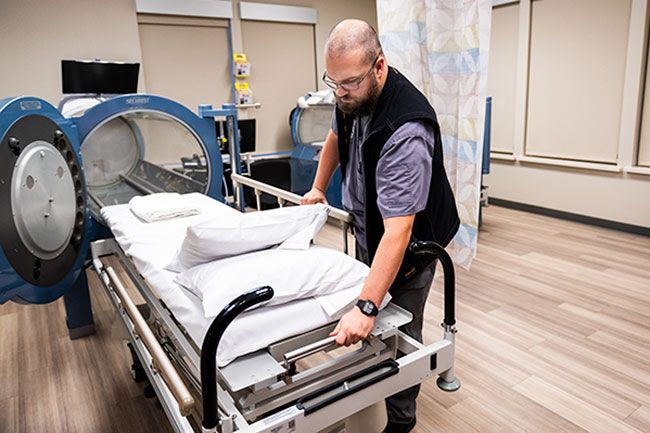
The care center, located in a separate office building west of the hospital, recently added staff to serve more patients in its two hyperbaric chambers. It now can treat up to six patients a day in McMinnville; otherwise, they would need to go to Portland or Eugene for hyperbaric treatment.
“There’s a great need for these services,” said Ryan Fernandez, director of the Wound Care & Hyperbaric Medicine center. Many patients are from Yamhill County, but they also travel from the coast, Salem, Corvallis and other areas of the state.
The chambers look like hospital beds enclosed in acrylic tubes. A patient lies down, slides into the tube and, after the door is sealed, spends 90 to 120 minutes in a pure oxygen environment. The treatment compresses the oxygen molecules so they can enter the bloodstream and diffuse into the tissues, stimulating capillary growth, said Bryce Green, the center’s hyperbaric safety director.
The process creates concentrated healing power to damaged tissue, Fernandez said. “It speeds up the healing process, especially for hard-to-heal wounds.”
Patients usually repeat the treatments daily, five days a week, for about eight weeks. The results are significantly different than using conventional bandages or medications, Fernandez said.
Wounds once considered untreatable now heal well, with little scarring, Green added. “Skin grafts look phenomenal,” he said.
Green joined the wound care center in October as its hyperbaric chamber operator and safety director. A former emergency medical services technician, he completed a week of training with Helogics in Jacksonville, Florida, specific to the operation of hyperbaric medicine and the pneumatically operated chambers used in McMinnville.
Green monitors the chambers and their oxygen supply daily to ensure safe operations.
He also guides patients through a lengthy orientation that takes about an hour before their first treatment and reviews a lengthy checklist each time thereafter to ensure they are ready.
New patients are taught to yawn or swallow to reduce pressure build-up in their ears, for instance, just as they would while flying. They are told they will feel warmer as the pressure increases, then cooler as it decreases at the end of treatment.
“We educate the patient so they’re not nervous,” Green said. “As long as we follow all the safety rules, it’s very safe, very good treatment.”
Using a hyperbaric chamber is like diving in the ocean, where the pressure increases as the diver swims deeper. In fact, Green said, treatments are referred to as “dives.”
Prior to a session, the patient puts on a cotton gown and lies on cotton sheets to reduce the possibility of static electricity. The patient also is grounded to the machinery.
Once in the sealed chamber, pure oxygen flows in, gradually increasing pressure in the tube to a level that is safe for the patient and will accomplish healing, Green said. After the prescribed time has passed, the oxygen level and pressure are lowered gradually until they are the same as the air outside the tube.
The same technique is used for divers who surface too quickly, to keep them from getting the bends — a condition caused by nitrogen bubbles building up in the bloodstream if pressure is released too quickly.
While the bends can be fatal, the hyperbaric wound treatment is safe, Green said, as long as the equipment is working properly and the treatment is administered correctly — which are his responsibilities.
“We have tremendous safety procedures,” he said.
Several other wound center staff members are trained to monitor the chamber if he must leave the room during a treatment, he said, but usually he remains with patients the entire time.
Each chamber is transparent, so he and the patient can see each other. Privacy curtains shield passersby from looking in.
The chambers are equipped with communications devices so the technician and patient can communicate, as well.
In addition, a television screen sits atop each chamber so the patient can view movies or shows; many do, Green said, although some just relax or nap throughout their treatment.
The hyperbaric chambers can be used by people of all ages, but not everyone qualifies — heart or lung issues or other medical conditions may make them ineligible. Most insurance companies cover the treatment if it is deemed medically necessary, but patients must be pre-qualified.
For more information about the wound center and hyperbaric care, call 503-472-5749 or go to willamettevalleymedical.com.









Comments