


Gary Conkling: Immigrants helped found U.S. and sustain it from the outset

About the writer: Gary Conkling started writing stories as a child and publishing them on his own hand-cranked printing press. Little did he know digital technology would make it possible to repeat the task as an adult by publishing his own blog, Life Notes. He is a journalist by trade who has worked in the trenches of public affairs at the federal, state, regional and local levels. But he also is an observer of life occurring around him. This piece is from his blog, found at https://garyconklinglifenotes.wordpress.com.
Immigration is intimately linked to American history. Thomas Jefferson listed obstruction of immigration among the grievances in the Declaration of Independence. Immigration was essential to populating the country.
Despite that, arguing over immigration isn’t new. Americans have argued over it for 250 years. The argument is unlikely to stop any time soon.
One fact is indisputable: Immigration made the United States possible.
Fifty percent of the Continental Army troops led by George Washington were born abroad. Eight of the 56 signers of the Declaration of Independence were foreign-born, and 10 others were the children of immigrants.
Four U.S. presidents were sons of immigrants. In fact, our eighth president — Martin Van Buren, elected in 1836 — was the first whose parents were both born in the United States.
Chester Arthur — our 21st president, elected in 1881 — was parented by a father born in Ireland. Barack Obama’s father was a Kenyan citizen living in Hawaii on a student visa.
The Statue of Liberty, created in France, was dedicated on Liberty Island in New York Harbor in 1886. Emma Lazarus penned the poem titled The New Colossus that featured the famous line, “Give me your tired, your poor, your huddled masses yearning to breathe free,” which became the emblem and promise of America.
Immigration was an issue debated during the Constitutional Convention. A Cato Institute article described how convention delegates arrived at the “most liberal policies in the world at that time.”
Benjamin Franklin favored liberal immigration to avoid discouraging “common people” from settling here. He said, “When foreigners after looking about for some other country in which they can obtain more happiness, give a preference to ours, it is a proof of attachment which ought to excite our confidence and affection.”
The consensus on naturalization became “the most open possible society where foreigners could aspire to full citizenship in a reasonable time frame and receive equal treatment to citizens as soon as possible.”
George Washington strongly encouraged immigration, favoring those with skills and resources. He believed in merging newcomers into American life through “intermixture” to “become one people.”
Alexander Hamilton, an immigrant himself, promoted immigration as a way to strengthen a young nation’s economy and population.
James Madison said in 1790 that America should be a haven for immigrants who could assimilate into American society and adopt American ideals.
Thomas Jefferson welcomed immigrants as a source of strength, asking, “Shall oppressed humanity find no asylum on this globe?” He worried though about pro-monarchy immigrants, fearing they could bring with them “dangerous anti-democratic ideas.”
“Immigration has played an important role in American history, and the United States continues to have the most open immigration policy in the world,” says the Center for Immigration Studies. “Before the era of rapid communications and transportation, America encouraged relatively open immigration to settle its empty lands.”
Friedrich Trump, Donald Trump’s paternal grandfather, immigrated to the United States from Germany in 1885, at age 16, to avoid mandatory military service. He arrived in New York in October 1885 and went on to earn a fortune in the restaurant and hotel business.
From 1900 to 1920, nearly 24 million immigrants, mostly from Europe, arrived on American shores in what was called the “Great Wave.” World War I reduced immigration, but it resumed after the end of the war, leading Congress in 1921 to pass a quota system favoring North European immigrants and establish the U.S. Border Patrol.
During the Depression, immigration sank to net zero. Immigration also remained relatively low for 20 years following the end of World War II.
Congress rewrote the immigration quota system and the naturalization process in the Nationality Act of 1952. And from 1942 to 1964, the Bracero Program brought 4 million Mexicans to work in American farm fields for low wages.
Under the 1948 Displaced Persons Act and 1953 Refugee Relief Act, more than 600,000 immigrants, many from war-ravaged Eastern Europe, including Holocaust survivors, were admitted to the United States. One such family moved into the Omaha neighborhood where I lived with my parents.
In 1965, Congress replaced the national origins immigration system with a system giving preference to uniting families and attracting skilled workers.
The majority of immigrants shifted from Northern Europeans to Asia and Latin America as a result, and numbers increased. The number of immigrants rose from 320,000 per year in the 1960s to more than 1 million per year by the 21st century.
The 1986 Immigration Reform and Control Act provided for amnesty, creating legal status for 3 million immigrants. It also contained enforcement provisions to prevent illegal entry. The 1990 statute increased immigration levels and expanded opportunity to “underrepresented countries.”
The U.S. Commission on Immigration Reform attempted to ensure “credibility of immigration policy can be measured by a simple yardstick: people who should get in, do get in; people who should not get in, are kept out; and people who are judged deportable are required to leave.”
In the 1990s, Congress also pardoned 578,000 illegal immigrants subject to a $1,000 fine and gave legal status to another 1 million immigrants, mostly from Central America.
The September 11 attacks sharply impacted immigration. It also triggered a series of conflicting bills that didn’t pass.
Public attitudes toward immigrant began to sharply diverge.
In his 2016 presidential campaign, Trump made immigration a major priority, including building a huge border wall. In his second term, Trump has made illegal immigration enforcement a top priority, which has resurrected conflicting public perspectives on immigration’s role.
The liberal immigration philosophy embraced by the Founding Fathers in the Constitution didn’t extend to the 400,000 Africans who were kidnapped and transported to America to work as slaves in mostly Southern plantations. By 1860, there were nearly 4 million enslaved people living in the United States without personal liberty or human rights.
Starting in the 1850s, California’s Gold Rush created a need for more workers, which led Chinese immigration to work mines and build railroads. In 1882, Congress enacted the Chinese Exclusion Act, which prompted employers to instead import Japanese, Korean and Filipino laborers, also deemed ineligible for citizenship.
The first Chinese immigrant to gain U.S. citizenship was Edward Bing Kan on Jan. 18, 1944.
Kan arrived in the United States at age 13 as a student, settling in Portland and marrying Katherine Wong, a U.S. born woman of Chinese descent who lost her citizenship when they married. They moved to Chicago, where Kan worked as a Chinese translator for 35 years, ironically at the Immigration and Naturalization Service.
Data indicates that 30% of America’s current workforce consists of immigrants or the sons and daughters of immigrants. From 1995 to 2022, immigrants and their children accounted for 70% of the growth of the U.S. workforce.
Trump administration’s aggressive deportation policy has affected many workers in the construction, transportation, warehousing, agriculture and services sectors, who hold a disproportionate share of lower-skill jobs that are hard to fill.
Immigrants have helped shape America’s economy in top corporate ranks, as well. They are responsible for founding more than 25% of U.S. venture-backed public companies.
Their ranks including Hungarian-born Andrew Grove at Intel and Russian-born Sergey Brin at Google. And let’s not forget Elon Musk from South Africa and Levi Strauss from Germany.
James Naismith, who invented basketball, was Canadian. Madeline Albright, America’s first female secretary of state, was Czechoslovakian.
Ardem Patapoutian, who won the 2021 Nobel Prize in Physiology, was Lebanese. Heman Bekele, named “America’s Top Young Scientist” in 2023 for developing a cancer-treating soap, was Ethiopian.
One-third of U.S. engineers and 27% of U.S. math and computer science professionals are immigrants. Lue Gim Gong, a Chinese-American horticulturist, revolutionized Florida’s citrus industry.
More than 25 percent of American physicians and surgeons are immigrants. Up to 17% of registered nurses and more than 40 percent of home health aides are immigrants.
In 2021, 2.8 million immigrants accounted for 18% of the 15.2 million people working in the U.S. health care system, which continues to struggle with a shortage of trained workers.
America’s history is closely linked to immigration and its progress tied to immigrants. Attitudes over time have varied. Immigrants have played critical roles in the American project, even when denied its democratic promise.
In celebrating our national birthday, we should ask ourselves whether current U.S. immigration policies are prudent or misguided. We should ask whether mass deportations represent the America we want. Are we the same nation that justified slavery and Black slaves to a fraction of a person for white voter representation?
If there’s any doubt, spend a few bucks to check your own ancestry and see how far removed you are from your immigrant forebears. Keep in mind, unless you can trace your heritage to Native American tribes, you are and will always be an American immigrant.
The basic question you should ask is, where would you be if your ancestors hadn’t found their way to America, and America hadn’t let them in to become productive citizens.






Comments
Bigfootlives
This is such a tired liberal gaslighting trope. No kidding that the inhabitants of the original 13 colonies were immigrants. Same old retread talking points.
America was not built by immigrants; it was built by citizens! People who were all too happy to become proud Americans. They didn't put down their new home, wave the flags of their former country in protest, and threaten to overthrow the government; they waved American flags and assimilated into the so-called melting pot.
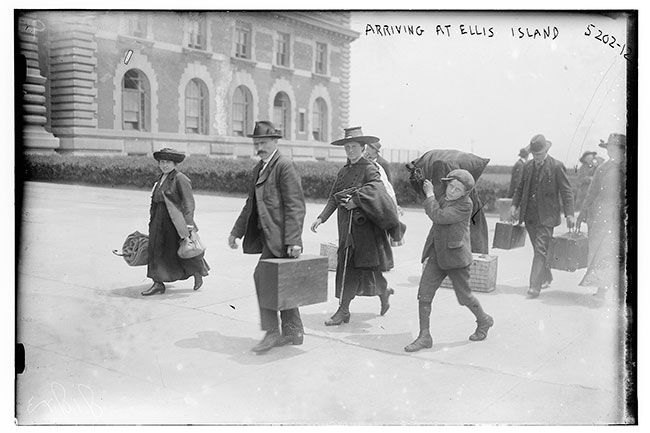
Let's talk about Ellis Island and the massive wave of European immigrants. They needed to prove that they had a skill and could support themselves; that they would not be a burden on society. They underwent a medical exam to ensure they were not bringing communicable diseases into the country. If they were deemed unworthy of entry, they were dropped off on the first boat home.
Liberals are desperate to reframe the Biden disaster as normal, historical immigration; it was anything but. We will see the true scope of the harm done to our republic with the tens of thousands of military-aged Chinese, Middle Eastern, and Russian foreign nationals in our country, unaccounted for. Someone will need to be held accountable, but by then it will be too late, and they will just blame Trump. Same tired gaslighting trope.