


Christine Bader: Chemeketa/WOU partnership creates rich new opportunities

About the writer: Christine Bader teaches in Linfield University’s master of science in business program, serves on the McMinnville School Board and coaches the Valley Panthers, a girls rugby club team. She played rugby at Amherst College in the early 1990s before embarking on a career that has spanned the private, public and nonprofit sectors. She lives in McMinnville with her husband and two children.
For Bobby Garibay, post-secondary education wasn’t in the cards. “I didn’t really care about high school,” he says, and it showed in his grades. “I really let them drop because I didn’t see myself going to college.”
Then he heard that Chemeketa Community College students can purchase a Western Oregon University Club Sport Player Pass for as little as $61.35 per term and participate in WOU club sports.
For Garibay, the opportunity to play rugby for WOU motivated him to improve his grades and continue his education. He’s now using an Oregon Promise grant to pay his tuition. He’s maintaining a 3.0 grade point average at Chemeketa Community College and recently went to rugby nationals with WOU.
Asked if he would be in school were it not for the Player Pass, he replied, “Absolutely not.” He is currently taking English classes, and plans to earn a paramedic license and become a firefighter.
Garibay is one of 17 student-athletes who’ve purchased a Player Pass in the 2025-26 academic year, the first full year of the program.
Andy Main, WOU’s associate director for campus recreation, is the mastermind of Player Pass.
A high school wrestler and football player, Main attended the University of Washington. He wasn’t going to make their Division I squads, but “found his people” in intramural and club sports there.
That experience turned into a career for him. He went to graduate school at the University of Tennessee in sports management, and landed at WOU after stints at Gonzaga and the Boys & Girls Club.
Upon arrival in Monmouth, he got acquainted with WOU’s men’s and women’s rugby clubs, and was inspired by the energy and impact of the program. In addition to his day job, he ended up serving in various roles with National Collegiate Rugby, including small college commissioner and president of the men’s conference.
Like everyone in secondary education, as the COVID-19 pandemic waned, Main brainstormed how to get students back to campus. He came across National Collegiate Rugby eligibility policy allowing students attending schools without rugby to play for nearby Division II and Division III teams, and Player Pass was born.
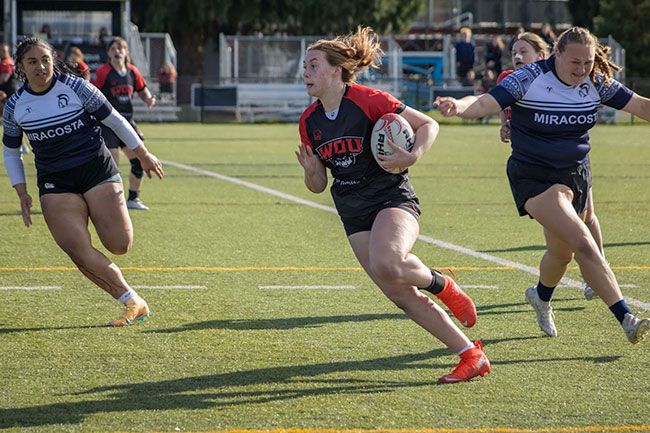
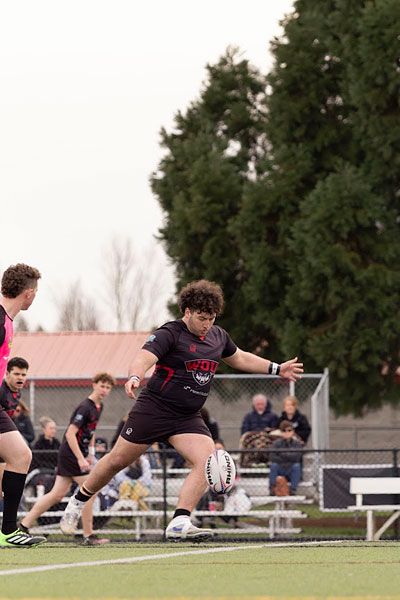
Approximately one-third of WOU’s men’s rugby club and one-half of its women’s rugby club are Player Pass participants.
WOU’s other club sports — dance, rock climbing, soccer, volleyball and men’s lacrosse — haven’t yet seen any uptake. One reason could be that the national governing bodies for lacrosse and volleyball don’t currently allow students at nearby schools to participate in sanctioned competitions like National Collegiate Rugby does, so Chemeketa students joining those WOU clubs would only be able to join practices and friendly matches.
Nonetheless, Main hopes the Player Pass continues to grow across all sports as word spreads, because so far. the program is providing a win-win-win.
Student-athletes get to compete as part of an athletic community, while earning a degree to continue their learning and broaden their career prospects. “I like the community and dedication of the team,” said WOU rugby player Leah Vipperman, an alumna of McMinnville’s Valley Panthers high school club who just finished her first year on the Player Pass.
Chemeketa gets students who wouldn’t have enrolled were it not for the opportunity to play for WOU. In fact, women have no other way to play collegiate rugby on an Oregon Promise grant, though men can also do so at Bend’s Central Oregon Community College, which fields its own club.
For its part, Main said, WOU gets “more students that are attracted to come and engage “ - and perhaps even enroll after completing their associate’s degree.
He said scholarships are generally less competitive for transfer students than for first-year students, so “if you do the community college route first, you’re much more likely to have a lower bill as a transfer student.”
Pricila Soto has found that to be the case.
A Valley Panthers alumna with Vipperman, and a state champion wrestler, Soto did not receive enough financial aid to enroll at WOU last fall. But she said, “When I heard about the Player Pass, it opened a door I thought was closed.”
She enrolled at Chemeketa, played rugby for WOU and ultimately became the first Player Pass athlete to announce plans to transfer to WOU, after receiving enough financial aid to make it possible. She is excited about WOU’s pre-nursing program, saying, “The Player Pass changed my path for the better.”
Bobby Garibay says rugby has paved the way for not only his career, but for life. He had wrestled and played football, but says that neither strengthened his resilience like rugby.
“In wrestling you can be lazy - you can go half on a move - but in rugby there’s no half,” he said. “The last three years playing has taught me so much about being mentally strong, physically strong. It’s taught me a lot.”
Jacob Parks is also playing rugby for WOU on a Player Pass. What opportunities has it created for him?
“Anything and everything,” he said. “Rugby’s opened a lot of doors.”
He recently competed with a national team at a tournament in Florida, and marveled at walking through the tunnel in April to play at the University of Iowa’s Kibbie Dome. “Even though we’re in community college, we’re going to step onto a university field and play other universities? It’s kind of surreal.”
Parks and Garibay are both living at home to save money, and have spent many nights on the couches in their teammates’ house near campus. “Food is not safe in that house,” Parks joked.
More importantly, they both cited how their teammates have been invaluable mentors on how to handle the challenges of school and post-high school life generally.
Garibay wants to assure high school players with poor grades that there is still hope, noting, “The grades don’t define them as people, as players.” Parks advocates for students to ask teachers for support if they started high school on the wrong foot but want to course-correct.
“They will definitely help you,” he said. “I was in the same boat. My grades weren’t good, so my junior and senior year, I was getting B’s and A’s just to bring (my GPA) up.”
Parks can’t imagine his life without this opportunity. “If it weren’t for the Player Pass,” he said, “I’d be at home doing nothing right now.”
Christine Bader teaches in Linfield University’s master of science in business program, serves on the McMinnville School Board and coaches the Valley Panthers, a girls rugby club team. She played rugby at Amherst College in the early 1990s before embarking on a career that has spanned the private, public and nonprofit sectors. She lives in McMinnville with her husband and two children.






Comments