


Kirby Neumann-Rea: Mind the GAPS
The concept of a “third place” — a social environment other than work or home — sometimes finds itself back at home. Or, on the road.
For some, it is the “man cave” tradition and its spinoff, the “she shed,” both of which will get a look here.
People carve out a personal space where they can, and they might give it a name. Hideaway House and Shadow Wing are two such places in McMinnville. And then there’s the big truck called Doolie.
For some context: Recent “Quirk of the Week” columns in the Wednesday e-edition of the News-Register have looked at things spotted in spaces such as porches, carports and backyards. This week it was a continued study of mostly DIY shelters and small buildings along roadsides.
The focus here will be on an interesting, related pair you might call “the odd couple,” prominent local examples of what you might call GAPS — “gender-asserting personal spaces.”
Call them manifestations of the “divine feminine” and “sacred masculine.” We like to think Paul McCartney was right: “Venus-and-Mars are alright tonight.”
The she shed is the arguably less-familiar term, feeling like a distaff response to the masculine man cave. The direct parallel construction would likely be “woman den.”
Diva den has been tried as well, but, uh — yeah, let’s go with she shed. Clever cave name alternatives — mantuary, man nest, bro cove — don’t seem to have ever taken hold either.
As with anything, it helps to find the humor in the subject. As Two Guys Who Blog wrote on the platform Medium, “Before the man cave, if a husband was lucky, we were lucky to have a recliner in the living room.”
I submit another option, for that guy who wants to install not a fridge or kegerator, but a full-on espresso bar, and call it “man cafe.” Or, since some people live in former churches, how about man nave?
There are many variations and perceptions imaginable for these GAPS, these man caves and she sheds. The local “odd couple” - one in McMinnville, the other in Yamhill - appear actively in use.
They are expressly labeled, respectively, “Man Cave” and “She Shed.” That’s it: no descriptor or modification in sight.
These local GAPS feel much more vibrant than the assorted neglected or abandoned shelters seen across the landscape. You can’t pan in or out like Google Earth, but here are some details:
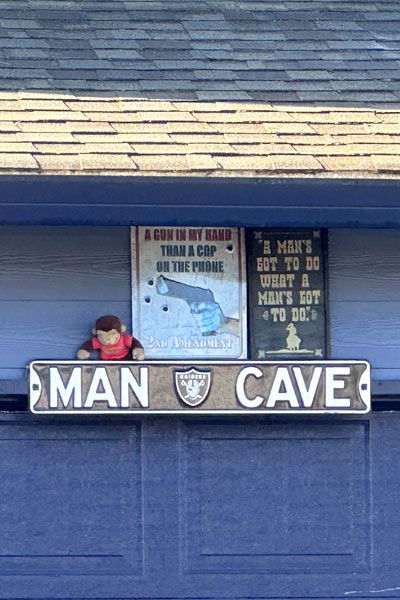
On a Taft Street garage, “Man Cave” is emblazoned on a metal sign resembling a standard street sign.
The sign is flanked by both a toy monkey and some Second Amendment signage. Simple and essentially laconic, with the simian flair, the combination of effects would seem to say, “For dudes only.”
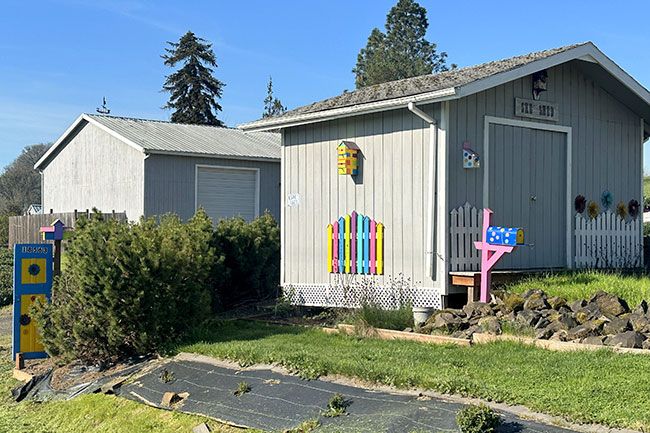
Moving on to Bony Road, north of Yamhill just off Highway 47, stands a she shed counterpart with a sign labeling it so.
The structure is adorned with a vividly colorful arbor. Nearby there are a mail box, some bird houses and an address sign, also in bright blue, yellow, red and green.
“Man cave” as a phrase has been around since March 1992, according to mancaves.org.
It originated in a Toronto Star column. You’ll need to thank a woman, Joanne Lovering, for the coinage.
In his 1993 book, “Men Are From Mars, Woman are From Venus,” John Gray used the metaphor of a man retreating to his “cave” in order to “process problems and engage in solitary activities like reading and gaming ...”
He went on to say, “Man caves became shrines to hobbies, equipped with refrigerators, pool tables, giant TVs, sports memorabilia” and other reflections of male camaraderie.
Books and television shows studying or glorifying man caves weathered criticism about perpetuating stereotypes and other issues. Mancaves.org noted, “Critics argued that man caves promoted a ‘corrosive masculinity,’ promoting selfish escape over family solidarity.”
It was natural that “She Sheds” would follow, as women felt the urge to create what the website called “analogous spaces.”
Not to be outdone, there is also a sheshed.com, which reports:
“Women with She Sheds,” capitalized on the site, “have gone a step further, beyond the bounds of home and outside to the back of the garden to their own personal space. She Sheds can be used to write ? or to paint, create, sculpt, whittle wood, clean fish, house hens, farm grow, store stuff or even live.”
This description provides a pretty massive distinction from tools, pool tables and big screen televisions of the man cave.
The website takes note, saying: “They are an offset to the man cave ? reflecting a broader trend toward gender-neutral domestic practices, as couples increasingly shared household duties.” I suppose it’s whatever helps either party avoid being in “the doghouse.”
The cave and shed terms have always been sort of jokey, implying a degree of secrecy or discretion regarding the very existence of the enclosed male or female reserves.
Culture has ascribed a certain territoriality to men who might possess a man cave.
In recent years, a television ad features a woman whose she shed catches fire. It captures her devotion to her space, and goes on to engage in a bit of parody on the “hands off my space” attitude we previously treated as a uniquely male attribute.
The terms are not fully parallel or gender opposites: men get a cave — suggesting dark mystery, while women are afforded only a shed — suggesting mere utility. It is yet another case of male-female imbalance, or at least it was at first.
The word “cave” always smirkily presumed that some modern-neanderthal macho ethos is something that guys aspire to. “Shed,” though cleverly repetitive, feels like just a reference to the structure, though doubtless many she shed owners have their own mythology about their space.
What I think men and women generally have in common in their GAPS is this:
Men might boast of their restrictive basement lair, and women might brag about their private backyard haven, but in both cases, it’s always in a kind of between-us mode.
They just go in and enjoy it. Those of the other gender might know about it, but they know to stay out of “our space.” A functioning open-secret discretion prevails over these personalized recreation environments, these GAPS.
Those of us without such a designated zone, this author included, might talk about the existence of such caves or sheds precisely because we are not in possession of one. It’s like the first rule of the man cave/she shed is that you don’t talk about the man cave/she shed.
Yet our local odd-couple signage belies this idea of quiet discretion. Indeed, the tenants of same make no secret to what lies within. Products such as the “man cave” sign have helped to commodify the individualist heart of GAPS.
These two local GAPS examples — that we know of — do not suggest a broad cultural trend. They are not necessarily indicative of the “sudden shifts in behavior and belief” described by author Malcolm Gladwell in his pair of books studying societal “tipping points.”
Even mancave.org supports a belief that the “trend” has faded after its heyday from the 1990s through around 2015. Yet the landscape is probably filled with sheds and caves that remain discreetly unlabeled, though no less valued by their owners.
The matter is not a pink-or-blue dichotomy, though it’s safe to say the bright reds and greens and yellows accompany the local she shed in ways harder to picture with any man cave. The vibrant palette of its colors may seem to suggest a feminine sensibility, or at least a clear difference from the typical man cave motif, but who’s to say what is said or done inside those cave or shed walls?
There’s no way of knowing if shed women don’t actively discuss gun-rights advocacy, nor if cave men aren’t in there painting pastel birdhouses.
Finally, I wonder if the expressly-labeled “man cave” feels like a dated exception, because so many men have replaced such a space with a masculine haven on the road: the massive, powerful and typically black trucks we increasingly see rumbling past with a solitary, male, 40-something driver in the cab and a bed lacking any visible load.
Of course, these things do serve to announce themselves in a large and loud fashion - not with a sign, but with high-and-blinding aftermarket LED headlights. Maybe it’s that some guys driving around in their Elevation Offgrid have simply found their own space.







Comments