


Christine Bader: Flag football push proves inequity persists in sports
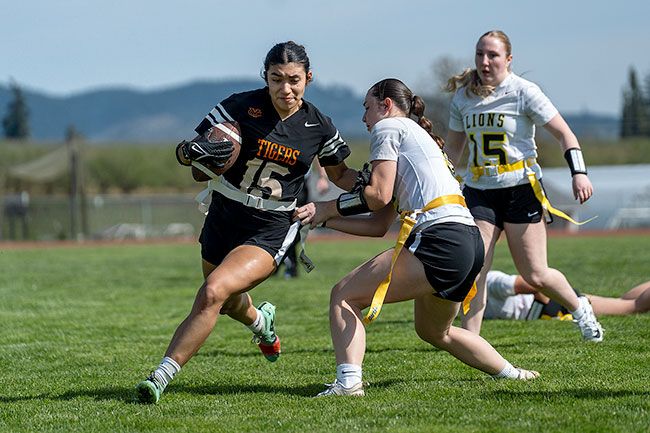

As the spring season approaches, many high school girls will have a new sport to choose from.
The National Football League is investing millions of dollars to make girls flag football the next big thing. It’s already a sanctioned high school sport in 17 states.
Oregon had 16 teams battle for its first high school state championship last spring, Yamhill Carlton among them. And it’s coming to the Olympics in 2028.
As a mom, former high school and college athlete and high school girls rugby coach, I support almost any opportunity for girls to play sports. Numerous studies indicate athletic participation leads to healthier lifestyles, stronger academic performance and even leadership positions in adult life.
But promoting flag football for girls assumes they’re not capable of full contact. This is simply wrong, exacerbating inequality rather than, well, tackling it.
In flag football, no contact is allowed — no tackling, diving, blocking or screening.
Instead, players wear two flags attached to a belt by either Velcro or a pop socket. To “tackle” a ball carrier, the opposing team needs to yank off one or both flags.
Flag football offers great opportunities to develop speed and agility. But it obviously lacks the physicality of the game boys are steered toward.
The problem is not that flag football exists. The problem is that it’s being promoted as the only version of the sport where girls can excel.
There is a lengthy history of gender inequality in sports.
Starting in the 1930s and continuing until 1974, girls were barred from Little League baseball, establishing softball as the female version of the sport. Women weren’t allowed to enter marathons until Boston in 1972, five years after Kathrine Switzer famously was shoved off that course by a race official.
That same year, Congress passed Title IX, requiring schools to provide equal athletic opportunity. But the legislation permits wide discretion over which sports, and which versions of sports, are offered.
Some variations make sense to account for physiological differences, like basketball’s smaller ball and tighter three-point arc. But tweaks like that don’t change the fundamental nature of the game.
To suggest girls need to be protected from physical contact is patronizing. I’ve coached girls of all shapes and sizes — some of whom had never played sports before — and seen them tackle players twice their size, then get up and do it over and over again.
That physical tenacity translates off the field. “Playing a contact sport definitely boosted my confidence,” said Waverly Phillips, who played for me as a McMinnville High School student and now plays at Western Oregon University.
Football is not the only sport refusing girls equal opportunity. Lacrosse and ice hockey allow body checking for boys but not girls.
Rugby and wrestling are the only full-contact sports where the rules are the same for female and male athletes.
This might account for the rapid growth in both sports among high school girls, even without the backing of a behemoth like the NFL — and in rugby’s case, without being a sanctioned school sport in most of the U.S.
According to USA Youth & High School Rugby, there are now more high school girls than boys playing rugby in the fall (many programs play both fall and spring), with 19% growth since the U.S. women won Olympic bronze in 2024.
In Oregon, new girls rugby teams are starting in Beaverton and Linn-Benton this spring, to compete against existing teams in Portland, Bend, Canby, Vancouver and Salem, as well as here in McMinnville.
Girls high school wrestling has seen similarly dramatic growth, from fewer than 12,000 participants nationwide a decade ago to 74,000 last year, according to the National Federation of State High School Associations. In Oregon, participation rose from about 200 girls to more than 1,200 over the same period.
Yes, girls can get hurt in contact sports — just like boys. But injury risk isn’t the issue.
The real harm lies in denying girls the chance to learn how strong they are, and to play by the same rules. No amount of NFL money and marketing can dress that up as progress.









Comments
WillieG
I've coached girls in tackle football, there is nothing holding them back from participation. Schools are having a hard time getting boys or girls on the field to play tackle football. The sad reality is that tackle football is a dying sport and it won't be long till flag football is the only form played by either sex.
Bigfootlives
Tackle football is dying? You must be a Cleveland Browns fan.